Guide
How to test if AI agents can buy from your store
Run two checks: a readiness check that reads your store the way agents do, then a test purchase with two or more agents, noting where each one stops. The free readiness report covers the first in about a minute, and the steps below cover the second in one sitting.
Run the free reportFive minutes to find out
In September an agent reported back that it had spent about five minutes in a browser before it could tell whether it could buy from a store. It got there in the end. A shopper waiting on the answer might not have stayed.
You can learn the same thing faster. Testing answers two questions: what an agent can read on your store, and what it does when it tries to buy. The free report answers the first in a minute. The second takes one sitting and two assistants.
What does the free report check?
Paste your store's address and the report reads it the way an agent would. It looks for a challenge or a block on your home page, reads robots.txt rule by rule for each AI app, opens your sitemap and product pages for price, identifiers and descriptions, and checks for a UCP profile, agent instructions and a way to buy.
Where it could not check something, it says so instead of guessing. The link opens with a summary to forward and a fix list for your developer.
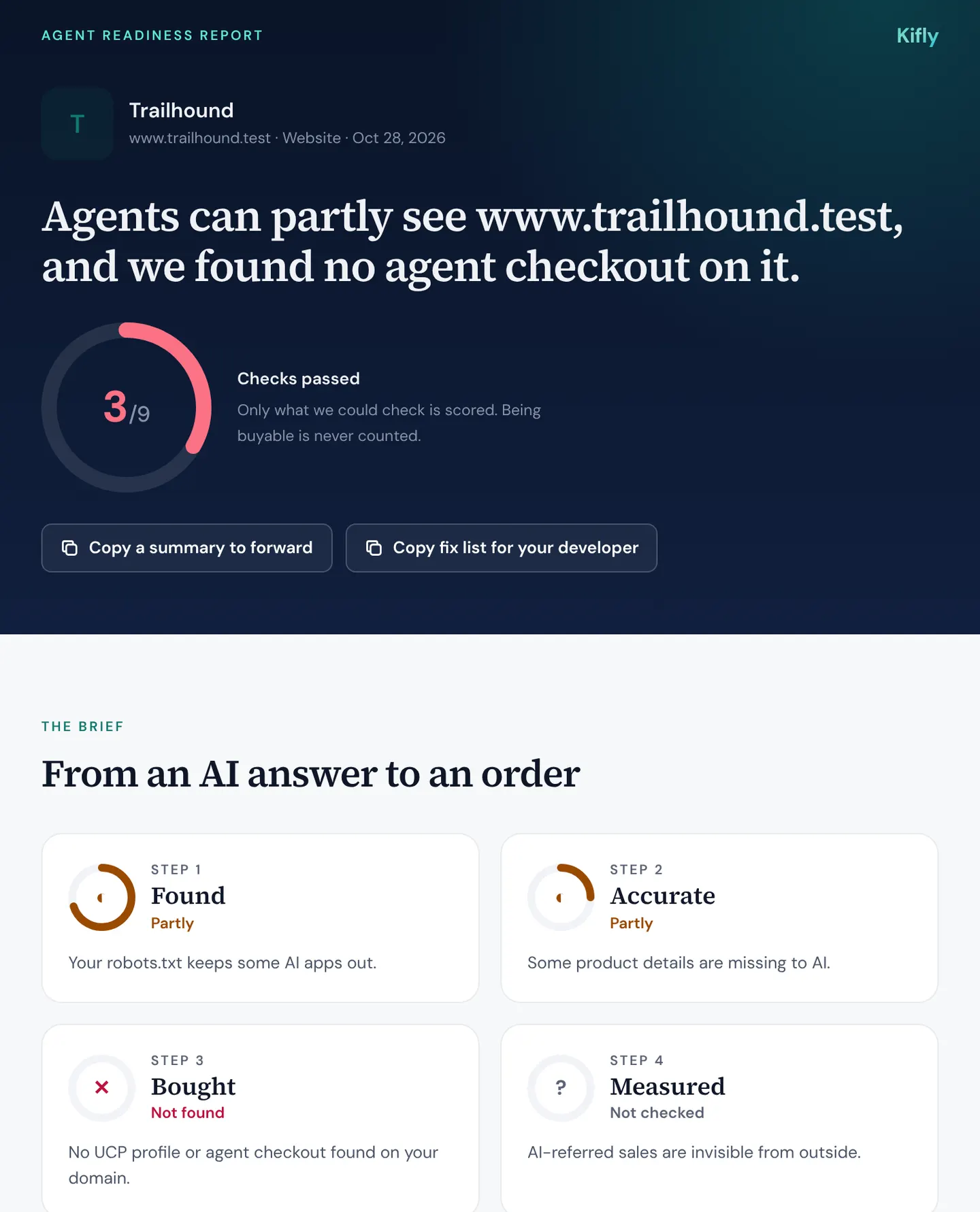
Run a test purchase
A report reads your pages. Only a purchase shows what an agent does with them.
- Pick one product with sizes or colours, and one without.
- Write one prompt with a need, a size, a budget and a date, for example: "Buy a medium waterproof dog jacket under $60 from yourstore.com, delivered by Friday, and tell me the return window."
- Give the same prompt to two or more assistants or agents.
- Score each run against the table below.
- Stop at the payment step unless you mean to buy. On a payment link, nothing is charged until the shopper confirms.
What a pass looks like
| Step | Pass | Fail looks like |
|---|---|---|
| Reach | The agent opens your store | "I couldn't access that site" |
| Price | It quotes your current price | An old price, or none |
| Variant | It picks the right size or colour | The default variant |
| Terms | It states your return window and delivery | "I couldn't find a return policy" |
| Payment | It reaches payment without signing in | A login page or a challenge |
Why test with more than one agent?
Agents behave differently at the same store. In a16z's benchmark, one agent reached a large retailer's cart in every run while three others were blocked in every attempt. Offers to connect a shopping app were rare too: 5% of runs at most.
Runs where the agent offered to connect a shopping app
Agents that never open your page
Agents that buy through an API look for a published checkout. Open yourstore.com/.well-known/ucp: a UCP profile there tells them how to search and check out. The report looks for it there, and on an agents. subdomain for platforms that reserve that address.
No profile means an API agent cannot buy from you directly, however good your pages are. Your site has not failed; that door is simply still shut.
A checklist to forward
- Run the free readiness report and note every failed check.
- Write one test prompt with a need, a size, a budget and a date.
- Run it with two or more agents.
- Score reach, price, variant, terms and payment for each.
- Fix the first step that fails, then run the same prompt again.
- Check yourstore.com/.well-known/ucp for a UCP profile.
- Run the free readiness report again after each fix.
Where Kifly fits
Stores on Kifly are purchasable by agents over UCP, MCP and REST, with a payment link the shopper confirms. The free report shows where your own store stands before you connect anything.
Questions sellers search
Can AI agents buy from my online store?
Browsing agents can, if nothing stops them at the cart: no required account and no bot check. Agents that buy through an API need a checkout they can call.